
Scientific Talk
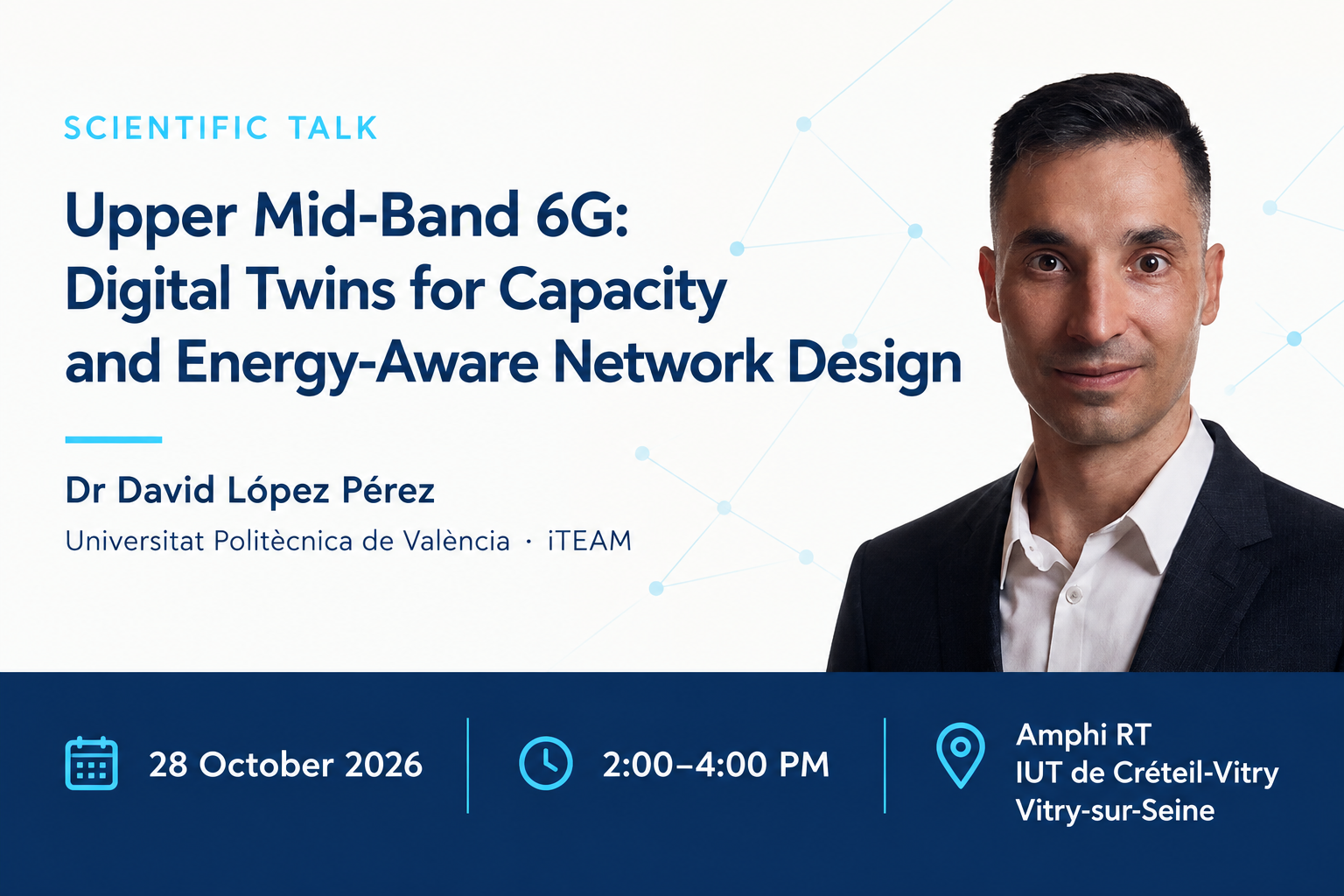
Upper Mid-Band 6G: Digital Twins for Capacity and Energy-Aware Network Design
Dr David López Pérez
Universitat Politècnica de València · iTEAM
Date: 28 October 2026 – Time: 2:00–4:00 PM
Location: Amphi RT, IUT de Créteil-Vitry, Vitry-sur-Seine
Abstract
What will define commercial 6G? Rather than being driven by a long list of disruptive features, the defining characteristic of 6G may be the emergence of an intelligent, continuously evolving network digital twin that supports the design, optimization, and operation of increasingly complex mobile networks.
This lecture presents that vision using upper mid-band 6G as a representative case study. Operation in FR3, combined with extreme massive MIMO and wider bandwidths, can deliver major capacity gains, but these gains come with important challenges in network complexity and energy consumption. As networks become denser, more directional, and more heterogeneous, conventional engineering approaches based on static models and manual optimization become increasingly insufficient.
A network digital twin provides a way to address this challenge. By combining realistic deployment models, propagation, traffic, beamforming, association, interference, throughput, and power-consumption models, the twin creates a virtual environment in which future network configurations can be evaluated before they are deployed. Using GIULIA, an open-source system-level simulation platform, we illustrate how such a framework can be used to analyze alternative 6G deployment strategies and their capacity–energy trade-offs.
The results show that FR3-based 6G can provide very large throughput gains over current multi-layer networks, but also that energy consumption can increase substantially as bandwidth, antenna dimensions, and transceiver counts scale. More importantly, the analysis shows that deployment strategy is critical: intelligent placement and proximity to traffic demand can improve both performance and throughput-per-watt efficiency compared with simpler infrastructure upgrades.
The main message is that future 6G networks will not only require new spectrum and larger antenna systems, but also a new way of engineering the network itself. Digital twins can become a central 6G capability, enabling operators to test, optimize, and continuously adapt network configurations while balancing capacity, coverage, interference, and energy consumption.
Short Biography
Dr David López-Pérez is a wireless communications researcher and Profesor Titular de Universidad at the Universitat Politècnica de València (UPV), affiliated with iTEAM. His work focuses on 6G, network digital twins, data-driven network optimization and energy-efficient communications. He earned his PhD at the University of Bedfordshire and conducted postdoctoral research at King’s College London. He previously held research and technical leadership roles at Nokia Bell Labs in Dublin and Huawei Technologies in Paris.